Merry Christmas!

Ho, Ho, Ho!

This blog is full of good stuff on the Joy of Christmas: Facts, Fun and Fantasy, for all those who love and can't get enough of Christmas!

There's lots here, so check the listing in the Blog Archive for the following:

- Traditions
- Story of Christ's Birth
- History of Santa
- World customs
- Scriptures
- Stories
- Prose
- Carols
- Meanings, symbols, origins
- Holiday greetings worldwide
- Facts and trivia
- Quotes
- Movie and TV clips
- Much more!

More will also be added. Let me know if there's something that should be here. Comments are appreciated!

To test your Christmas knowledge, see the trivia quiz at the bottom of this page!

12/8/12

A Christmas Carol: The Ghost of Christmas Past

Excerpts from Charles Dickens' "A Christmas Carol", regarding the Ghost of Christmas Past:

(for more excerpts, see below)

 'Are you the Spirit, sir, whose coming was foretold to me?' asked Scrooge.

   'I am.'

   The voice was soft and gentle. Singularly low, as if instead of being so close beside him, it were at a distance.

   'Who, and what are you?' Scrooge demanded.

   'I am the Ghost of Christmas Past.'

   'Long Past?' inquired Scrooge: observant of its dwarfish stature.

   'No. Your past.'

   Perhaps, Scrooge could not have told anybody why, if anybody could have asked him; but he had a special desire to see the Spirit in his cap; and begged him to be covered.

   'What!' exclaimed the Ghost, 'would you so soon put out, with worldly hands, the light I give. Is it not enough that you are one of those whose passions made this cap, and force me through whole trains of years to wear it low upon my brow?'

   Scrooge reverently disclaimed all intention to offend or any knowledge of having wilfully bonneted the Spirit at any period of his life. He then made bold to inquire what business brought him there.

   'Your welfare!' said the Ghost.

   Scrooge expressed himself much obliged, but could not help thinking that a night of unbroken rest would have been more conducive to that end. The Spirit must have heard him thinking, for it said immediately:

   'Your reclamation, then. Take heed!'

   It put out its strong hand as it spoke, and clasped him gently by the arm.

   'Rise! and walk with me!'

   It would have been in vain for Scrooge to plead that the weather and the hour were not adapted to pedestrian purposes; that bed was warm, and the thermometer a long way below freezing; that he was clad but lightly in his slippers, dressing-gown, and nightcap; and that he had a cold upon him at that time. The grasp, though gentle as a woman's hand, was not to be resisted. He rose: but finding that the Spirit made towards the window, clasped his robe in supplication.

  'I am mortal,' Scrooge remonstrated, 'and liable to fall.'

 'Bear but a touch of my hand there,' said the Spirit, laying it upon his heart, 'and you shall be upheld in more than this!'

   As the words were spoken, they passed through the wall, and stood upon an open country road, with fields on either hand. The city had entirely vanished. Not a vestige of it was to be seen. The darkness and the mist had vanished with it, for it was a clear, cold, winter day, with snow upon the ground.

   'Good Heaven!' said Scrooge, clasping his hands together, as he looked about him. 'I was bred in this place. I was a boy here!'

   The Spirit gazed upon him mildly. Its gentle touch, though it had been light and instantaneous, appeared still present to the old man's sense of feeling. He was conscious of a thousand odours floating in the air, each one connected with a thousand thoughts, and hopes, and joys, and cares long, long, forgotten.

   'Your lip is trembling,' said the Ghost. 'And what is that upon your cheek?'

   Scrooge muttered, with an unusual catching in his voice, that it was a pimple; and begged the Ghost to lead him where he would.

   'You recollect the way?' inquired the Spirit.

   'Remember it!' cried Scrooge with fervour; ' I could walk it blindfold.'

  'Strange to have forgotten it for so many years!' observed the Ghost. 'Let us go on.'

   They walked along the road, Scrooge recognizing every gate, and post, and tree; until a little market-town appeared in the distance, with its bridge, its church, and winding river. Some shaggy ponies now were seen trotting towards them with boys upon their backs, who called to other boys in country gigs and carts, driven by farmers. All these boys were in great spirits, and shouted to each other, until the broad fields were so full of merry music, that the crisp air laughed to hear it.

   'These are but shadows of the things that have been,' said the Ghost. 'They have no consciousness of us.'

  The jocund travellers came on; and as they came, Scrooge knew and named them every one. Why was he rejoiced beyond all bounds to see them? Why did his cold eye glisten, and his heart leap up as they went past? Why was he filled with gladness when he heard them give each other Merry Christmas, as they parted at cross-roads and bye-ways, for their several homes? What was merry Christmas to Scrooge? Out upon merry Christmas! What good had it ever done to him?

  'The school is not quite deserted,' said the Ghost. 'A solitary child, neglected by his friends, is left there still.'

   Scrooge said he knew it. And he sobbed.

  They left the high-road, by a well-remembered lane, and soon approached a mansion of dull red brick, with a little weathercock-surmounted cupola, on the roof, and a bell hanging in it. They went, the Ghost and Scrooge, across the hall, to a door at the back of the house. It opened before them, and disclosed a long, bare, melancholy room, made barer still by lines of plain deal forms and desks. At one of these a lonely boy was reading near a feeble fire; and Scrooge sat down upon a form, and wept to see his poor forgotten self as he used to be.

   The Spirit touched him on the arm, and pointed to his younger self, intent upon his reading.  Then, he said, in pity for his former self, 'Poor boy.' and cried again.

   'I wish,' Scrooge muttered, putting his hand in his pocket, and looking about him, after drying his eyes with his cuff: 'but it's too late now.'

   'What is the matter?' asked the Spirit.

   'Nothing,' said Scrooge. 'Nothing. There was a boy singing a Christmas Carol at my door last night. I should like to have given him something: that's all.'

   The Ghost smiled thoughtfully, and waved its hand: saying as it did so, 'Let us see another Christmas!'
....there he was, alone again, when all the other boys had gone home for the jolly holidays.

   He was not reading now, but walking up and down despairingly. Scrooge looked at the Ghost, and with a mournful shaking of his head, glanced anxiously towards the door.

   It opened; and a little girl, much younger than the boy, came darting in, and putting her arms about his neck, and often kissing him, addressed him as her 'Dear, dear brother.'

   'I have come to bring you home, dear brother!' said the
child, clapping her tiny hands, and bending down to laugh. 'To bring you home, home, home!'

   'Home, little Fan?' returned the boy.

   'Yes!' said the child, brimful of glee. 'Home, for good and all. Home, for ever and ever. Father is so much kinder than he used to be, that home's like Heaven! He spoke so gently to me one dear night when I was going to bed, that I was not afraid to ask him once more if you might come home; and he said Yes, you should; and sent me in a coach to bring you. And you're to be a man!' said the child, opening her eyes,' and are never to come back here; but first, we're to be together all the Christmas long, and have the merriest time in all the world.'

   'You are quite a woman, little Fan!' exclaimed the boy.

   She clapped her hands and laughed, and tried to touch his head; but being too little, laughed again, and stood on tiptoe to embrace him. Then she began to drag him, in her childish eagerness, towards the door; and he, nothing loathe to go, accompanied her.

   'Always a delicate creature, whom a breath might have withered,' said the Ghost. 'But she had a large heart.'

   'So she had,' cried Scrooge. 'You're right. I will not gainsay it, Spirit. God forbid!'

  'She died a woman,' said the Ghost, 'and had, as I think, children.'

   'One child,' Scrooge returned.

   'True,' said the Ghost. 'Your nephew.'

   Scrooge seemed uneasy in his mind; and answered briefly, 'Yes.'

   Although they had but that moment left the school behind them, they were now in the busy thoroughfares of a city, where shadowy passengers passed and repassed; where shadowy carts and coaches battle for the way, and all the strife and tumult of a real city were. It was made plain enough, by the dressing of the shops, that here too it was Christmas time again; but it was evening, and the streets were lighted up.

   The Ghost stopped at a certain warehouse door, and asked Scrooge if he knew it.

  'Know it!' said Scrooge. 'Was I apprenticed here?'

  They went in. At sight of an old gentleman in a Welsh wig, sitting behind such a high desk, that if he had been two inches taller he must have knocked his head against the ceiling, Scrooge cried in great excitement:

   'Why, it's old Fezziwig! Bless his heart; it's Fezziwig alive again!'

   Old Fezziwig laid down his pen, and looked up at the clock, which pointed to the hour of seven. He rubbed his hands; adjusted his capacious waistcoat; laughed all over himself, from his shoes to his organ of benevolence; and called out in a comfortable, oily, rich, fat, jovial voice:

   'Yo ho, there! Ebenezer! Dick!'

  Scrooge's former self, now grown a young man, came briskly in, accompanied by his fellow-prentice.
   'Dick Wilkins, to be sure.' said Scrooge to the Ghost. 'Bless me, yes. There he is. He was very much attached to me, was Dick. Poor Dick. Dear, dear.'

  'Yo ho, my boys!' said Fezziwig. 'No more work to-night. Christmas Eve, Dick. Christmas, Ebenezer! Let's have the shutters up,' cried old Fezziwig, with a sharp clap of his hands, 'before a man can say Jack Robinson!'

   You wouldn't believe how those two fellows went at it. They charged into the street with the shutters-one, two, three-had them up in their places-four, five, six-barred them and pinned then-seven, eight, nine-and came back before you could have got to twelve, panting like race-horses.

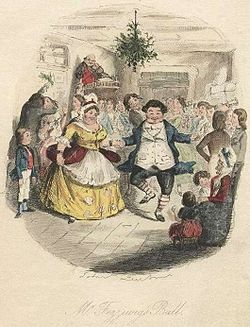
   'Hilli-ho!' cried old Fezziwig, skipping down from the high desk, with wonderful agility. 'Clear away, my lads, and let's have lots of room here! Hilli-ho, Dick! Chirrup, Ebenezer!'

   Clear away! There was nothing they wouldn't have cleared away, or couldn't have cleared away, with old Fezziwig looking on. It was done in a minute. Every movable was packed off, as if it were dismissed from public life for evermore; the floor was swept and watered, the lamps were trimmed, fuel was heaped upon the fire; and the warehouse was as snug, and warm, and dry, and bright a ball-room, as you would desire to see upon a winter's night.

   In came a fiddler with a music-book, and went up to the lofty desk, and made an orchestra of it, and tuned like fifty stomach-aches. In came Mrs Fezziwig, one vast substantial smile. In came the three Miss Fezziwigs, beaming and lovable. In came the six young followers whose hearts they broke. In came all the young men and women employed in the business. In came the housemaid, with her cousin, the baker. In came the cook, with her brother's particular friend, the milkman. In came the boy from over the way, who was suspected of not having board enough from his master; trying to hide himself behind the girl from next door but one, who was proved to have had her ears pulled by her mistress. In they all came, one after another; some shyly, some boldly, some gracefully, some awkwardly, some pushing, some pulling; in they all came, anyhow and everyhow. 

Away they all went, twenty couple at once; hands half round and back again the other way; down the middle and up again; round and round in various stages of affectionate grouping; old top couple always turning up in the wrong place; new top couple starting off again, as soon as they got there; all top couples at last, and not a bottom one to help them. 

   There were more dances, and there were forfeits, and more dances, and there was cake, and there was negus, and there was a great piece of Cold Roast, and there was a great piece of Cold Boiled, and there were mince-pies, and plenty of beer. But the great effect of the evening came after the Roast and Boiled, when the fiddler (an artful dog, mind. The sort of man who knew his business better than you or I could have told it him.) struck up 'Sir Roger de Coverley.'

   Then old Fezziwig stood out to dance with Mrs Fezziwig. Top couple, too; with a good stiff piece of work cut out for them; three or four and twenty pair of partners; people who were not to be trifled with; people who would dance, and had no notion of walking.

  When the clock struck eleven, this domestic ball broke up. Mr and Mrs Fezziwig took their stations, one on either side of the door, and shaking hands with every person individually as he or she went out, wished him or her a Merry Christmas. When everybody had retired but the two prentices, they did the same to them; and thus the cheerful voices died away, and the lads were left to their beds; which were under a counter in the back-shop.

  During the whole of this time, Scrooge had acted like a man out of his wits. His heart and soul were in the scene, and with his former self. He corroborated everything, remembered everything, enjoyed everything, and underwent the strangest agitation. It was not until now, when the bright faces of his former self and Dick were turned from them, that he remembered the Ghost, and became conscious that it was looking full upon him, while the light upon its head burnt very clear.

   'A small matter,' said the Ghost, 'to make these silly folks so full of gratitude.'

   'Small!' echoed Scrooge.

   The Spirit signed to him to listen to the two apprentices, who were pouring out their hearts in praise of Fezziwig: and when he had done so, said, 'Why! Is it not? He has spent but a few pounds of your mortal money: three or four perhaps. Is that so much that he deserves this praise?'

   'It isn't that,' said Scrooge, heated by the remark, and speaking unconsciously like his former, not his latter, self. 'It isn't that, Spirit. He has the power to render us happy or unhappy; to make our service light or burdensome; a pleasure or a toil. Say that his power lies in words and looks; in things so slight and insignificant that it is impossible to add and count them up: what then? The happiness he gives, is quite as great as if it cost a fortune.'

   He felt the Spirit's glance, and stopped.

   'What is the matter?' asked the Ghost.

   'Nothing in particular,' said Scrooge.

   'Something, I think?' the Ghost insisted.

   'No,' said Scrooge, 'No. I should like to be able to say a word or two to my clerk just now. That's all.'

   His former self turned down the lamps as he gave utterance to the wish; and Scrooge and the Ghost again stood side by side in the open air.

   'My time grows short,' observed the Spirit. 'Quick!'

   This was not addressed to Scrooge, or to any one whom he could see, but it produced an immediate effect. For again Scrooge saw himself. He was older now; a man in the prime of life. His face had not the harsh and rigid lines of later years; but it had begun to wear the signs of care and avarice. There was an eager, greedy, restless motion in the eye, which showed the passion that had taken root, and where the shadow of the growing tree would fall.

   He was not alone, but sat by the side of a fair young girl in a mourning-dress: in whose eyes there were tears, which sparkled in the light that shone out of the Ghost of Christmas Past.

   'It matters little,' she said, softly. 'To you, very little. Another idol has displaced me; and if it can cheer and comfort you in time to come, as I would have tried to do, I have no just cause to grieve.'

   'What Idol has displaced you?' he rejoined.

   'A golden one.'

   'This is the even-handed dealing of the world.' he said. 'There is nothing on which it is so hard as poverty; and there is nothing it professes to condemn with such severity as the pursuit of wealth!'

   'You fear the world too much,' she answered, gently. 'All your other hopes have merged into the hope of being beyond the chance of its sordid reproach. I have seen your nobler aspirations fall off one by one, until the master-passion, Gain, engrosses you. Have I not?'

   'What then?' he retorted. 'Even if I have grown so much wiser, what then? I am not changed towards you.'

   She shook her head.

   'Am I?'

   'Our contract is an old one. It was made when we were both poor and content to be so, until, in good season, we could improve our worldly fortune by our patient industry. You are changed. When it was made, you were another man.'

   'I was a boy,' he said impatiently.

   'Your own feeling tells you that you were not what you are,' she returned. 'I am. That which promised happiness when we were one in heart, is fraught with misery now that we are two. How often and how keenly I have thought of this, I will not say. It is enough that I have thought of it, and can release you.'

  'Have I ever sought release?'

  'In words. No. Never.'

   'In what, then?'

   'In a changed nature; in an altered spirit; in another atmosphere of life; another Hope as its great end. In everything that made my love of any worth or value in your sight. If this had never been between us,' said the girl, looking mildly, but with steadiness, upon him; 'tell me, would you seek me out and try to win me now. Ah, no!'

   He seemed to yield to the justice of this supposition, in spite of himself. But he said with a struggle, 'You think not.'

   'I would gladly think otherwise if I could,' she answered, 'Heaven knows! When I have learned a Truth like this, I know how strong and irresistible it must be. But if you were free to-day, to-morrow, yesterday, can even I believe that you would choose a dowerless girl-you who, in your very confidence with her, weigh everything by Gain: or, choosing her, if for a moment you were false enough to your one guiding principle to do so, do I not know that your repentance and regret would surely follow? I do; and I release you. With a full heart, for the love of him you once were.'

   He was about to speak; but with her head turned from him, she resumed.

   'You may-the memory of what is past half makes me hope you will-have pain in this. A very, very brief time, and you will dismiss the recollection of it, gladly, as an unprofitable dream, from which it happened well that you awoke. May you be happy in the life you have chosen!'

   She left him, and they parted.

   'Spirit!' said Scrooge, 'show me no more! Conduct me home. Why do you delight to torture me?'
   'I told you these were shadows of the things that have been,' said the Ghost. 'That they are what they are, do not blame me!'

   'Remove me!' Scrooge exclaimed, 'I cannot bear it!'

   He turned upon the Ghost, and seeing that it looked upon him with a face, in which in some strange way there were fragments of all the faces it had shown him, wrestled with it.

   'Leave me! Take me back! Haunt me no longer!'

   He was conscious of being exhausted, and overcome by an irresistible drowsiness; and, further, of being in his own bedroom. He gave the cap a parting squeeze, in which his hand relaxed; and had barely time to reel to bed, before he sank into a heavy sleep.

------

For more excerpts from "A Christmas Carol", see:
A Christmas Carol: The Visit of Marleys Ghost
A Christmas Carol: The Ghost of Christmas Present
A Christmas Carol: The Ghost of Christmas Yet to Come
A Christmas Carol: Scrooge's Redemption

12/7/12

White Christmas Movie Finale

Mormon Tabernacle Choir - Hallelujah

Jingle Bells - Frank Sinatra & Bing Crosby

A Charlie Brown Christmas (The Meaning of Christmas)

Bing Crosby sings White Christmas in "Holiday Inn"

The Preacher's Wife "I Love the Lord" Whitney Houston

Santa Claus The Movie

Swedish Christmas Trivia


Hyacinths are popular plants for Christmas. Around 12 million hyacinths are bought in Sweden during the Christmas season.

Put the pepper in pepparkakor (ginger snaps). In the old days the richer you were, the more pepper you put into your ginger snaps, or pepparkakor, since pepper was an expensive spice. The pepparkaka is an old tradition with origins in Caesar’s Rome. In Scandinavia during the Middle Ages, the pepparkakor were thought to have medicinal properties.

Scandinavians have graced their windows with adventsstjärnor (advent stars) since the1930’s.

Glögg (mulled wine) became a Scandinavian Christmas tradition about 100 years ago, although spiced, alcoholic beverages were popular already since the Middle Ages. In Sweden  gløgg is served with  lussekatter (saffron buns).

The Julbock (Christmas goat) harkens back to the old Norse God, Thor, who would ride in a wagon drawn by goats. It’s one of the oldest Scandinavian Christmas symbols.

The Christmas tree arrived in Scandinavia from Germany during the mid 1700’s. The first trees were hung from the ceiling as most houses had too little space to otherwise display them, and one wanted to protect the tree with all its decorations.

Many Swedish households have one or more electric candlesticks in their windows. Just like the menorah, these candlesticks have seven branches. Oskar Andersson in Sweden made the first electric candlestick in 1934. You will also see electrically lit stars of paper, wood, straw or perforated metal hanging in the windows. Introduced from Germany around 1910, these adventsstjärnor are typical during the Advent celebrations.

For over 500 years, Finns, Swedes, and Norwegians have been consuming lutfisk or lutefisk, an air-dried whitefish soaked in lye. Legend has it that the Brits tried to poison the Vikings by giving them fish steeped in lye – the Vikings, however, not only tolerated the lye fish, they fell in love with the dish so much that they brought it home, and have been enjoying it ever since.

Advent candlesticks (often decorated) became popular in the 1920’s when they were first sold in stores. A candlestick has four candles which mark the four Sundays of Advent. A new candle is lit each Sunday before Christmas.

An old tradition prevails in Sweden that the twelve days of Christmas are declared by law to be time of civil peace.

In Sweden a third of the annual turnover of toys takes place during the Christmas shopping.

Advent calendars have been a main Christmas staple for Scandinavian children since World War II. These 3-dimensional calendars have twenty-four windows, one of which is opened every day from December 1 to December 24. The tradition is originally German.

Rhyming is another popular Christmas activity from the old days. There are the julklappsrim, short little doggerels for the Christmas gifts, and also grötrim: Nobody was allowed to dive into their bowls of porridge unless they had first improvised a short verse in honor of either the porridge or someone at the table.

Julkärve, a Christmas sheaf, is a Swedish tradition of saving the finest sheaf of grain for the birds at Christmas time. The sheaf is tied to trees or high poles.

For more on Swedish Christmas, go to:

http://joychristmas.blogspot.com/2012/11/the-swedish-christmas.html

Several other links are also included there.

12/6/12

Barbra Streisand - Jingle Bells

Dan Fogelberg - The First Christmas Morning


Away in the east shines a star in the sky
That leads us to where He is born
And bearing good tidings and gifts we shall give
To Him on this first Christmas morning

Holy our journey and holy our love
That takes us to find and adore Him
And blessed the baby that sleeps in his bed
And wakes on this first Christmas morning

Ahhh-Ahhh Alleluia
Ahhh-Ahhh Alleluia
Ahhh-Ahhh Alle
Ahhh-Ahhh Alle
Ahhh-Ahhh Alleluia

The Lord in His wisdom, the Lord in His grace
Has given to man a redeemer
To save us from sin and to show us the light
That shines on this first Christmas morning
And will shine ever each Christmas morning
[Repeat Alleluia]

David Archuleta and the Mormon Tabernacle Choir:Joy To The World

Christmas Clip: Barbara Mandrell Christmas Songs

12/4/12

A Christmas Carol: The Visit of Marley's Ghost

Excerpts from Charles Dickens' "A Christmas Carol",  regarding the visit of Marley's Ghost:
(for more excerpts, see below)

Now, it is a fact, that there was nothing at all particular about the knocker on the door, except that it was very large. It is also a fact, that Scrooge had seen it, night and morning, during his whole residence in that place; also that Scrooge had as little of what is called fancy about him as any man in the city of London, even including-which is a bold word- the corporation, aldermen, and livery.

Let it also be borne in mind that Scrooge had not bestowed one thought on Marley, since his last mention of his seven-year's dead partner that afternoon. And then let any man explain to me, if he can, how it happened that Scrooge, having his key in the lock of the door, saw in the knocker, without its undergoing any intermediate process of change-not a knocker, but Marley's face.

Marley's face. It was not in impenetrable shadow as the other objects in the yard were, but had a dismal light about it, like a bad lobster in a dark cellar. It was not angry or ferocious, but looked at Scrooge as Marley used to look: with ghostly spectacles turned up on its ghostly forehead. The hair was curiously stirred, as if by breath or hot air; and, though the eyes were wide open, they were perfectly motionless. That, and its livid colour, made it horrible; but its horror seemed to be in spite of the face and beyond its control, rather than a part of its own expression.

As Scrooge looked fixedly at this phenomenon, it was a knocker again.

To say that he was not startled, or that his blood was not conscious of a terrible sensation to which it had been a stranger from infancy, would be untrue. But he put his hand upon the key he had relinquished, turned it sturdily, walked in, and lighted his candle.

He did pause, with a moment's irresolution, before he shut the door; and he did look cautiously behind it first, as if he half expected to be terrified with the sight of Marley's pigtail sticking out into the hall. But there was nothing on the back of the door, except the screws and nuts that held the knocker on, so he said'Pooh, pooh.' and closed it with a bang.

The sound resounded through the house like thunder. Every room above, and every cask in the wine-merchant's cellars below, appeared to have a separate peal of echoes of its own. Scrooge was not a man to be frightened by echoes. He fastened the door, and walked across the hall, and up the stairs; slowly too: trimming his candle as he went.

Up Scrooge went, not caring a button for that. Darkness is cheap, and Scrooge liked it. But before he shut his heavy door, he walked through his rooms to see that all was right. He had just enough recollection of the face to desire to do that.

Sitting-room, bed-room, lumber-room. All as they should be. Nobody under the table, nobody under the sofa; a small fire in the grate; spoon and basin ready; and the little saucepan of gruel (Scrooge has a cold in his head) upon the hob. Nobody under the bed; nobody in the closet'; nobody in his dressing-gown, which was hanging up in a suspicious attitude against the wall. Lumber-room as usual. Old fire-guard, old shoes, two fish-baskets, washing-stand on three legs, and a poker.

Quite satisfied, he closed his door, and locked himself in; double-locked himself in, which was not his custom. Thus secured against surprise, he took off his cravat; put on his dressing-gown and slippers, and his nightcap; and sat down before the fire to take his gruel.

It was a very low fire indeed; nothing on such a bitter night. He was obliged to sit close to it, and brood over it, before he could extract the least sensation of warmth from such a handful of fuel. 

'Humbug!' said Scrooge; and walked across the room.

After several turns, he sat down again. As he threw his head back in the chair, his glance happened to rest upon a bell, a disused bell, that hung in the room, and communicated for some purpose now forgotten with a chamber in the highest story of the building. It was with great astonishment, and with a strange, inexplicable dread, that as he looked, he saw this bell begin to swing. It swung so softly in the outset that it scarcely made a sound; but soon it rang out loudly, and so did every bell in the house.

This might have lasted half a minute, or a minute, but it seemed an hour. The bells ceased as they had begun, together. They were succeeded by a clanking noise, deep down below; as if some person were dragging a heavy chain over the casks in the wine-merchant's cellar. Scrooge then remembered to have heard that ghosts in haunted houses were described as dragging chains.

The cellar-door flew open with a booming sound, and then he heard the noise much louder, on the floors below; then coming up the stairs; then coming straight towards his door.

'It's humbug still!' said Scrooge. 'I won't believe it.'

His colour changed though, when, without a pause, it came on through the heavy door, and passed into the room before his eyes. Upon its coming in, the dying flame leaped up, as though it cried, 'I know him; Marley's Ghost!' and fell again.

I know him! Marley's ghost!

The same face: the very same. Marley in his pigtail, usual waistcoat, tights and boots; the tassels on the latter bristling, like his pigtail, and his coat-skirts, and the hair upon his head. The chain he drew was clasped about his middle. It was long, and wound about him like a tail; and it was made (for Scrooge observed it closely) of cash-boxes, keys, padlocks, ledgers, deeds, and heavy purses wrought in steel. His body was transparent; so that Scrooge, observing him, and looking through his waistcoat, could see the two buttons on his coat behind.

Scrooge had often heard it said that Marley had no bowels, but he had never believed it until now.

No, nor did he believe it even now. Though he looked the phantom through and through, and saw it standing before him; though he felt the chilling influence of its death-cold eyes; and marked the very texture of the folded kerchief bound about its head and chin, which wrapper he had not observed before; he was still incredulous, and fought against his senses.

'How now.' said Scrooge, caustic and cold as ever. 'What do you want with me?'

'Much.'-Marley's voice, no doubt about it.

'Who are you?'

'Ask me who I was.'

'Who were you then?' said Scrooge, raising his voice. 'You're particular, for a shade.' He was going to say 'to a shade,' but substituted this, as more appropriate.

'In life I was your partner, Jacob Marley.'

'Can you-can you sit down?' asked Scrooge, looking doubtfully at him.

'I can.'

'Do it, then.'

"Marley's Ghost."

Scrooge asked the question, because he didn't know whether a ghost so transparent might find himself in a condition to take a chair; and felt that in the event of its being impossible, it might involve the necessity of an embarrassing explanation. But the ghost sat down on the opposite side of the fireplace, as if he were quite used to it.

'You don't believe in me,' observed the Ghost.

'I don't,' said Scrooge.

'What evidence would you have of my reality beyond that of your senses?'

'I don't know,' said Scrooge.

'Why do you doubt your senses?'

'Because,' said Scrooge, 'a little thing affects them. A slight disorder of the stomach makes them cheats. You may be an undigested bit of beef, a blot of mustard, a crumb of cheese, a fragment of an underdone potato. There's more of gravy than of grave about you, whatever you are!'

'You see this toothpick.' said Scrooge, returning quickly to the charge, for the reason just assigned; and wishing, though it were only for a second, to divert the vision's stony gaze from himself.

'I do,' replied the Ghost.

'You are not looking at it,' said Scrooge.

'But I see it,' said the Ghost, 'notwithstanding.'

'Well.' returned Scrooge, 'I have but to swallow this, and be for the rest of my days persecuted by a legion of goblins, all of my own creation. Humbug, I tell you. humbug!'

At this the spirit raised a frightful cry, and shook its chain with such a dismal and appalling noise, that Scrooge held on tight to his chair, to save himself from falling in a swoon. But how much greater was his horror, when the phantom taking off the bandage round its head, as if it were too warm to wear in-doors, its lower jaw dropped down upon its breast.

Scrooge fell upon his knees, and clasped his hands before his face.

'Mercy!' he said. 'Dreadful apparition, why do you trouble me?' 'Man of the worldly mind!' replied the Ghost, 'do you believe in me or not?'

'I do,' said Scrooge. 'I must. But why do spirits walk the earth, and why do they come to me?'

'It is required of every man,' the Ghost returned, 'that the spirit within him should walk abroad among his fellow-men, and travel far and wide; and if that spirit goes not forth in life, it is condemned to do so after death. It is doomed to wander through the world-oh, woe is me!-and witness what it cannot share, but might have shared on earth, and turned to happiness.'

Again the spectre raised a cry, and shook its chain and wrung its shadowy hands.

'You are fettered,' said Scrooge, trembling. 'Tell me why?'

'I wear the chain I forged in life,' replied the Ghost. 'I made it link by link, and yard by yard; I girded it on of my own free will, and of my own free will I wore it. Is its pattern strange to you?'

Scrooge trembled more and more.

'Or would you know,' pursued the Ghost, 'the weight and length of the strong coil you bear yourself? It was full as heavy and as long as this, seven Christmas Eves ago. You have laboured on it, since. It is a ponderous chain!'

Scrooge glanced about him on the floor, in the expectation of finding himself surrounded by some fifty or sixty fathoms of iron cable: but he could see nothing.

'Jacob,' he said, imploringly. 'Old Jacob Marley, tell me more. Speak comfort to me, Jacob.'

'I have none to give,' the Ghost replied. 'It comes from other regions, Ebenezer Scrooge, and is conveyed by other ministers, to other kinds of men. Nor can I tell you what I would. A very little more is all permitted to me. I cannot rest, I cannot stay, I cannot linger anywhere. My spirit never walked beyond out counting-house-mark me!- in life my spirit never roved beyond the narrow limits of our money-changing hole; and weary journeys lie before me.'

'You must have been very slow about it, Jacob,' Scrooge observed, in a business-like manner, though with humility and deference.

'Slow!' the Ghost repeated.

'Seven years dead,' mused Scrooge. 'And travelling all the time?'

'The whole time,' said the Ghost. 'No rest, no peace. Incessant torture of remorse.'

'You travel fast?' said Scrooge.

'On the wings of the wind,' replied the Ghost.

'You might have got over a great quantity of ground in seven years,' said Scrooge.

The Ghost, on hearing this, set up another cry, and clanked its chain so hideously in the dead silence of the night, that the Ward would have been justified in indicting it for a nuisance.

'Oh! captive, bound, and double-ironed,' cried the phantom, 'not to know, that ages of incessant labour by immortal creatures, for this earth must pass into eternity before the good of which it is susceptible is all developed! Not to know that any Christian spirit working kindly in its little sphere, whatever it may be, will find its mortal life too short for its vast means of usefulness! Not to know that no space of regret can make amends for one life's opportunity misused! Yet such was I! Oh! such was I!'

'But you were always a good man of business, Jacob,' faltered Scrooge, who now began to apply this to himself.

'Business!' cried the Ghost, wringing its hands again. 'Mankind was my business. The common welfare was my business; charity, mercy, forbearance, and benevolence, were, all, my business. The dealings of my trade were but a drop of water in the comprehensive ocean of my business!'

It held up its chain at arm's length, as if that were the cause of all its unavailing grief, and flung it heavily upon the ground again.

'At this time of the rolling year,' the spectre said, 'I suffer most. Why did I walk through crowds of fellow-beings with my eyes turned down, and never raise them to that blessed Star which led the Wise Men to a poor abode? Were there no poor homes to which its light would have conducted me?'

Scrooge was very much dismayed to hear the spectre going on at this rate, and began to quake exceedingly.

'Hear me!' cried the Ghost. 'My time is nearly gone. I am here to-night to warn you, that you have yet a chance and hope of escaping my fate. A chance and hope of my procuring, Ebenezer.'

'You were always a good friend to me,' said Scrooge. 'Thank'ee.'

'You will be haunted,' resumed the Ghost, 'by Three Spirits.'

Scrooge's countenance fell almost as low as the Ghost's had done.

'Is that the chance and hope you mentioned, Jacob?' he demanded, in a faltering voice.

'It is.'

'I-I think I'd rather not,' said Scrooge.

'Without their visits,' said the Ghost, 'you cannot hope to shun the path I tread. Expect the first to-morrow, when the bell tolls One.'

'Couldn't I take them all at once, and have it over, Jacob?' hinted Scrooge.

'Expect the second on the next night at the same hour. The third upon the next night when the last stroke of Twelve has ceased to vibrate. Look to see me no more; and look that, for your own sake, you remember what has passed between us!'

------

For more excerpts from "A Christmas Carol", see these posts:
A Christmas Carol: Scrooge's Nephew Wishes Merry Christmas
A Christmas Carol: Scrooge's Redemption
http://joychristmas.blogspot.com/2012/12/a-christmas-carol-ghost-of-christmas.html
http://joychristmas.blogspot.com/2012/12/a-christmas-carol-ghost-of-christmas_10.html

12/3/12

The Christmas Heart

Let us remember that the Christmas heart is a giving heart, a wide open heart that thinks of others first. The birth of the baby Jesus stands as the most significant event in all history, because it has meant the pouring into a sick world the healing medicine of love which has transformed all manner of hearts for almost two thousand years... Underneath all the bulging bundles is this beating Christmas heart.

- George Matthew Adams

11/29/12

The Swedish Christmas


Christmas in Sweden, as in other countries, is a mixture of old and new, religious and secular, native and foreign, according to the Swedish professor of folklore Jan-Öjvind Swahn.

In Sweden, Christmas is by law a time of civil peace.  Christmas in Sweden includes more days off, both for schoolchildren and for adults, than any other festival, and in some years the number of working days in between public holidays and weekends can be so small that, by docking a couple of days from their year’s holiday, people can be off work from anything up to two weeks.

Swedish Christmas cards (in this day and age more often computer based) are nearly always “white,” with deep snow as a standing invitation to skiing, but the fact is that white Christmases are very few and far between in the southern third of the country.

Christmas food is one of the really ancient elements of Christmas, but this too is changing. Once upon a time the Christmas menu differed a great deal as between coastal and inland communities, north and south, fishing and farming folk, and so on. Nowadays, with most of the raw material coming from factories, local variations have given way to a centrally orchestrated selection of manufactured or semi-manufactured products.

Pork make up a strikingly large proportion of Christmas fare, and visitors sometimes wonder why the Swedes have to celebrate the birth of their Savior by eating pig meat. The historical reason is that, for a long time, salt pork was the meat ration of the Swedes all year round. Pigs were slaughtered in the autumn, when they were fattest, the pork was preserved in brine and would then have to last until the following autumn. One or two “Christmas pigs” were held over from the fall butchering, however, and reprieved until Lucia. Christmas was the only time of year when people could eat fresh meat, which in those days was the height of enjoyment. No such considerations apply nowadays, but so conservative are our habits, especially on festive occasions, that for many people Christmas would not be Christmas without ham, brawn and pork sausage.

Nordstjernan's Eva Stenskär spoke with one of the lecturers at the University of Washington, Seattle about Christmas:

“Sweden had a state church from the year 1500 to 2000, and thus Christmas is steeped in the Lutheran traditions,” says Ia Dübois, Senior Lecturer at the Department of Scandinavian Studies at the University of Washington. “Advent is an important event with the lighting of the four Advent candles each Sunday. Christmas decorations are taken out on the first of Advent and include adventstjärna, a large electrically lit star made of wood, metal, or paper and is placed in the window, little elves, gingerbread houses, tomtar, and julbockar.”

The main meal, explains Dübois, is served on Christmas Eve and consists of a smorgasbord of meatballs, ribs, cold cuts, lutfisk, different kinds of herring and cabbage, and centers around the Christmas ham. And then there’s the dopp i grytan (dipping in the kettle) tradition, when you dip bits of bread in the broth leftover after boiling the ham. For dessert there’s risgrynsgröt (rice porridge) with a hidden almond.

“The one who gets it will have a prosperous year ahead,” Dübois says.

------

Pepparkakor (Ginger Snaps) Recipe
Strongly 'addictive' and a classic in every way around Christmas in Sweden.

10 Oz unsalted butter (2 sticks and a couple of tblsp)
1 ¾ cup sugar
1 cup golden syrup (“ljus sirap”)
1 cup water
1 tbsp baking soda (hjortronsalt or bikarbonat) mixed in with flour
6 1/3 cup flour
½ tbsp ground ginger
½ tbsp ground cinnamon
½ tbsp ground cloves

Mix butter, syrup, sugar and spices
Add water
Mix in flour and baking soda
Refrigerate for 12 hours
Roll the pastry thinly and cut out ginger snaps with a cutter
Bake the ginger snaps at 375-400F in oven.

Frosting (optional)
½ cup confectioners sugar
2 tsp water
Place confectiorners sugar in a bowl and gradually add water until frosting is firm
Decorater the ginger snaps with the frosting, let rest until dry

11/27/12

Christmas at Temple Square

There are many great places for seeing beautiful Christmas lights and feeling the spirit of Christmas.  One of those is at Temple Square in Salt Lake City, including the grounds and visitors centers at the Salt Lake Temple.  Not only lights, but several nativity scenes (including a narrated story), Christmas films, the Mormon Tabernacle Choir Christmas Concerts, and a focus on what the holiday is all about - Jesus Christ!

Here are some photos of our recent visits:


Mormon Tabernacle Choir Christmas Concert


Photos by Ken R. Young

11/26/12

What Christmas Is All About


Without this there would be no Christmas or "holiday" (the word "holiday" comes from "holy day") season as we know it today. The fun and joy of our Christmas holiday has all been derived or added unto, one way or another, because of the advent of Our Savior.

Those who celebrate Santa or some other non-descript holiday fun without recognizing the source are missing the point.

Still, I am glad for all who make merry for any reason at this time.

The Twelve Days of Christmas: How Much it Costs in 2012

An article by Kevin Begos with The Associated Press:

Add seven swans, six geese and five golden rings to the list of Christmas gifts that cost more than they did a year ago.
And if you get all 364 items repeated throughout "The Twelve Days of Christmas" carol, you'll pay 6.1 percent more this year, according to the so-called Christmas Price Index that PNC Wealth Management updates annually.

That comes to $107,300.

"The rise is larger than expected considering the modest economic growth we've had," said Jim Dunigan, managing executive of investments for PNC. He noted the government's Consumer Price Index has risen just 2 percent in the 12 months before September.

Thrifty shoppers may find some reasons for cheer. Six items mentioned in the song haven't gone up in price: maids-a-milking, ladies dancing, lords-a-leaping, calling birds, turtle doves and the partridge. The eight maids-a-milking still cost just $58 because the minimum wage hasn't risen.

Twelve drummers drumming ($2,775.50) and eleven pipers piping ($2,562) might also be considered relative bargains compared to seven swans, which will set you back $7,000. Nine ladies dancing will cost you $6,294.03.

Dunigan said the 2011 drought caused the prices of some birds to soar, partly because of corn and other feed costs.

"The geese were up 29.6 percent, and swans were up 11 percent," Dunigan said, adding that none of the gifts in the song went down in price this year.

The price of a pear tree is $189.99, an 11.8 percent jump from last year's $169.99. Five gold rings jumped 16.3 percent this year, to $750, and three French hens are now $165, instead of $150.

The $15 partridge is the cheapest item, and swans the most expensive, at $1,000 each.

Last-minute shoppers who turn to the Internet will pay a bit more for the gifts. Buying one set of the core items in each verse costs $24,431 in traditional stores this year, but $40,440 online. Part of that difference is the extra expense of shipping live birds, Dunigan said, adding that Internet costs rose 1.5 percent compared to last year.

PNC Financial Services Group Inc. checks jewelry stores, dance companies, pet stores and other sources to compile the list. Some of its sources this year include the National Aviary in Pittsburgh and the Philadelphia-based Pennsylvania Ballet Company.

This year's list:

•Partridge, $15; last year: same

•Pear tree, $189.99; last year: 169.99

•Two turtle doves, $125; last year: same

•Three French hens, $165; last year: $150

•Four calling birds (canaries), $519.96; last year: same

•Five gold rings, $750; last year: $645

•Six geese a-laying, $210; last year: $162

•Seven swans a-swimming, $7,000; last year: $6,300

•Eight maids a-milking, $58; last year: same

•Nine ladies dancing (per performance), $6,294; last year: same

•10 lords a-leaping (per performance), $4,767; last year: same

•11 pipers piping (per performance), $2,562; last year: $2,428

•12 drummers drumming (per performance), $2,776; last year: $2,630

See also:

Origins of the Twelve Days of Christmas

The Cost of Twelve Days of Christmas - 2013

11/21/12

Christmas Trivia: True or False?

The answers to the following can be found within the various posts on this blog, as well as below...

Holiday Names and Greetings

1. “X-mas” is an irreverent, non-Christian name for the holiday.

2. “Noel” comes from Old French, meaning “new birth”.

3. “Yule” comes from an ancient Viking celebration of the turning of the sun.

4. “Feliz Navidad” directly translated into English means “Happy Birth”.

5. “Mele Kalikimaka” is Hawaiian for “enjoy the holiday feast”.

The Nativity of Jesus

6. Modern calendar years are based on the verified year of the birth of Christ.

7. The number of visitors, known as Magi, Wise Men or Kings, was three.

8. The Wise Men, or Kings, came to see the newborn baby lying in the manger.

9. Early Christians believed Christ was born on December 25th.

10. Shepherds watched their flocks on the cold winter’s night of Christ’s birth.

The Twelve Days of Christmas
11. The Twelve Days of Christmas begin on December 13th.

12. The gifts given on each day in the song represent items at a Christmas party.

13. The “Two Turtle Doves” represented the Old and New Testaments.

14. The last two gifts were 11 lords a leaping and 12 drummers drumming.

Santa Claus

15. St. Nicholas, who preceded Santa Claus, was born in Germany in 1622.

16. Santa’s flying sleigh and reindeer originated from stories in the 1800’s.

17. Although he’s known by many names in many places, Santa is always a man.

18. Kris Kringle was the name of an early Dutch Santa Claus figure.

19. Santa Claus is largely unknown in places like Japan and China.

Reindeer

20. Rudolph’s story was a promotional creation of Montgomery Ward stores.

21. Blixen is the name of Santa’s eighth reindeer.

22. Donner, the seventh reindeer, is sometimes incorrectly called Donder.

23. The reindeer were first named in “Twas the Night Before Christmas”.

24. Instead of reindeer, in Sweden, a goat pulls Santa’s (Tomten’s) sled.

Christmas Trees

25. The custom of decorating trees for Christmas originated in Germany.

26. Before the 1500’s, Christmas trees were considered a pagan custom.

27. Martin Luther is credited with first putting candles, or lights, on the tree.

28. There is no mention of a Christmas tree in Dicken’s “A Christmas Carol.”

29. Hanging the tree upside down from the ceiling used to be popular.

Miscellaneous
30. The first Christmas card was created and sent in London in 1840.

31. The most popular selling Christmas Carol of all time is “Silent Night”.

32. Mistletoe used to be hung for enemies to meet under and call a truce.

33. Poinsettias were first brought to the U.S. from Mexico by Mr. Poinsett.

34. Christmas mince pie contained rabbit, pheasant and partridge meat.

35. “Nog” in eggnog refers to a heavy noggin (head) from drinking too much.

36. The tradition of filling stockings originated in the country of Turkey.

37. Sleigh rides with jingle bells is a favorite Christmas activity in Australia.

38. Celebrating Christmas was once outlawed in Merry Olde England.

39. Candy canes were created to keep children quiet during church services.

40. Swedish Christmas celebrates St. Lucia, who helped needy people in Italy.

Answers:

1. False. “X” comes from the Greek letter that start’s Christ’s name and represents Christ.
2. True. Oui, oui. Noel is tres French, an old word which is related to the nouvelle, meaning “new”.
3. True. The word “yule” is old Norse for wheel, meaning the wheel in the sky that turns to give more light.
4. True. “Feliz” means “happy”. “Navidad” translates to nativity, which also means birth.
5. False. It means nothing in Hawaiian. It is an attempt to spell English “Merry Christmas” using Hawaiian letters.
6. False. There is no historical verification to the year of Christ’s birth. Some scholars believe it was in 2 to 4 B.C.
7. False. Three gifts are mentioned, but no number of the visitors is given. Some believe there were 12 or more.
8. False. They arrived well after Christ was born, and most likely saw him inside a home in a regular bed.
9. False. No exact date was known. When Romans became Christian, the Dec. 25th date replaced a pagan holiday.
10. False. Shepherds were not in the fields with their flocks during winter. This most likely occurred in the spring.
11. False. They start on Christmas Day, Dec. 25th, and last until Jan. 6th, the Eastern Orthodox Christmas Day.
12. True. In Old England, a party was held on “12th Night”. All the gifts were represented through food or fun.
13. True. The gifts and numbers were created to represent / disguise gospel principles for early persecuted believers.
14. False. There are 10 lords a leaping, not 11. Correct answer: 11 pipers piping, 12 drummers drumming.
15. False. St. Nicholas was born in Asia Minor, now known as Turkey, sometime during the 3rd Century.
16. False. The idea originated from early legends of Viking gods flying through the skies on animal-pulled sleighs.
17. False. In Italy, the gift giver is an old woman known as La Befana. In parts of Russia, she is known as Babushka.
18. False. Kris Kringle is an Americanization of the German gift giver “Christ-kindl”, or “Christ Child”.
19. False. Santa Claus has become a popular holiday figure in both Japan and China, not necessarily for Christmas.
20. True. It was a 1939 promotional gimmick given to those who did Christmas shopping at Montgomery Ward.
21. False. The name of the eighth reindeer is spelled Blitzen, not Blixen.
22. False. The original text of “Twas the Night Before Christmas” spells the seventh reindeer’s name as Donder.
23. True. “Twas the Night Before Christmas” by Clement C. Moore was the first text that named the eight reindeer.
24. True. Although many reindeer are in Northern Sweden, Tomten rides a sled through the forest pulled by a goat.
25. False. The Germans adapted modern tree traditions from customs of the ancient Romans and Celtic druids.
26. False. 7th Century Catholic monk St. Boniface used the indoor evergreen’s triangle shape to teach of the Godhead.
27. True. Legend claims Martin Luther first put candles on his tree, to represent the light of Christ for his children.
28. True. Christmas trees did not become popular in England until after Dickens wrote “A Christmas Carol”.
29. True. Many trees were originally hung upside down in Old Europe and in early Pennsylvania settlements.
30. True. John C. Horsley created his own card in 1840. The idea caught on, and his card was re-printed in 1843.
31. False. Although “Silent Night” is popular in many countries, Bing Crosby’s “White Christmas” is the top seller.
32. True. Used for many things, mistletoe brought people together, including those who needed to kiss and make-up.
33. True. Joel Roberts Poinsett, Ambassador to Mexico, introduced the “Holy Night Flowers” to the U.S. in 1825.
34. True. Originally, mince pie was a meat pie. Fruits and spices were later added, and then the meat was dropped.
35. False. “Nog” is another term for “grog”, which is a rum-based drink. Eggnog is sometimes served with rum.
36. True. St. Nicholas, who lived in Turkey, is claimed to have assisted the needy by leaving gold coins in stockings.
37. False. Christmas in Australia occurs during summertime. A beach barbecue is a popular Christmas Day event.
38. True. From 1645 to 1660, because of Oliver Cromwell and the Puritans, celebrating Christmas was illegal.
39. True. A Cologne Cathedral Choirmaster gave shepherds crook-shaped candy to kids during long nativity services.
40. True. Though celebrated in Sweden, Lucia’s legend began with her Christian services and martyrdom in Italy.

Correct Answers Rating:40 - Cheater, you peeked! Not even Santa knew all of these.
35 to 39 - Next in line to be Santa. How’s your “ho, ho, ho”?
30 to 34 - A true Christmas elf. Santa’s looking to promote you.
25 to 29 - On Santa’s Nice List, but you could do better.
20 to 24 - Rockin’ around the Christmas tree, but you’re missing some good stuff.
15 to 19 - You like Christmas, but your favorite holiday is Halloween, right?
10 to 14 - Christmas is coming, and you haven’t got a ha’penny. God bless you.
Less than 10 - Bah humbug. You need to pay more attention if you want more than coal in your stocking. Better watch out or you’ll get run over by a reindeer.

Ben Stein: A Jew's Confession About Christmas

The following was written by Ben Stein, an American actor, writer, lawyer, and commentator on political and economic issues.  This was recited by him on television on a CBS Sunday Morning Commentary.


My confession:

I am a Jew, and every single one of my ancestors was Jewish. And it does not bother me even a little bit when people call those beautiful lit up, bejewelled trees, Christmas trees. I don't feel threatened. I don't feel discriminated against. That's what they are, Christmas trees.

It doesn't bother me a bit when people say, “Merry Christmas” to me. I don't think they are slighting me or getting ready to put me in a ghetto. In fact, I kind of like it. It shows that we are all brothers and sisters celebrating this happy time of year. It doesn't bother me at all that there is a manger scene on display at a key intersection near my beach house in Malibu. If people want a crib, it's just as fine with me as is the Menorah a few hundred yards away.

I don't like getting pushed around for being a Jew, and I don't think Christians like getting pushed around for being Christians.

- Ben Stein

11/13/12

The Rockefeller Center Christmas Tree


The Rockefeller Center Christmas Tree is a large Christmas tree placed annually in Rockefeller Center in mid-town Manhattan in New York City. The tree is erected and lit in late November or early December. In recent years, the lighting has been broadcast live nationwide on NBC's Christmas in Rockefeller Center show. The tree, usually a Norway spruce 69 to 100 feet (21 to 30 m) tall, has been put up every year since 1933.

An 80-foot Norway spruce that made it through Superstorm Sandy was transformed into a beacon of shimmering glory Wednesday Nov. 28th when New York City Mayor Michael Bloomberg and others turned its lights on at Rockefeller Center for the 80th Christmas tree lighting. 

Officials turned on the lights just before 9 p.m. Wednesday in the 80th annual celebration. Prior to that, the tree-lighting event include performances from Rod Stewart, CeeLo Green, Scotty McCreery, Il Volo, Victoria Justice, Brooke White, Mariah Carey, Trace Adkins and Tony Bennett, along with appearances by Billy Crystal and Bette Midler.

The tree, which weighs 10 tons and is 50 feet in diameter, was loaded on a 115-foot-long flatbed truck and erected at Rockefeller Center on Wednesday, November 14. Workers then strung 45,000 lights on the branches.

The unofficial tradition began during the Depression-era construction of Rockefeller Center, when workers decorated a smaller 20 feet (6.1 m) balsam fir tree with "strings of cranberries, garlands of paper, and even a few tin cans" on Christmas Eve (December 24, 1931), as recounted by Daniel Okrent in his history of Rockefeller Center. Some accounts have the tree decorated with the tin foil ends of blasting caps. There was no Rockefeller Center Christmas tree in 1932.

The tallest Christmas tree at Rockefeller Center was a 100 feet (30 m) spruce erected on November 11, 1999.

The decorated Christmas tree remains lit at Rockefeller Center through January 6, which is the Christian feast of The Epiphany. 
After its stint in the spotlight, it will be turned into lumber for Habitat for Humanity.

8/14/12

Christmas Gifts: Four Gifts from God

For a few moments, may we set aside the catalogs of Christmas, with their gifts of exotic description. Let’s even turn from the flowers for Mother, the special tie for Father, the cute doll, the train that whistles, the long-awaited bicycle—even the “Star Trek” books and videos—and direct our thoughts to those God-given gifts that endure. I have chosen from a long list just four:

1. The gift of birth.
2. The gift of peace.
3. The gift of love.
4. The gift of life eternal.

First, the gift of birth. It has been universally bestowed on each of us. Ours was the divine privilege to depart our heavenly home to tabernacle in the flesh and to demonstrate by our lives our worthiness and qualifications to one day return to Him, precious loved ones, and a kingdom called celestial. Our mothers and our fathers bestowed this marvelous gift on us. Ours is the responsibility to show our gratitude by the actions of our lives.

Second, the gift of peace. In the raucous world in which we live, the din of traffic, the blaring commercials of the media, and the sheer demands placed on our time—to say nothing of the problems of the world—cause headache, inflict pain, and sap our strength to cope. The burden of sickness or the grief of mourning a loved one departed brings us to our knees seeking heavenly help. With the ancients we may wonder, “Is there no balm in Gilead?” There is a certain sadness, even hopelessness, in the verse:

There is never a life without sadness,
There is never a heart free from pain;
If one seeks in this world for true solace,
He seeks it forever in vain.

He who was burdened with sorrow and acquainted with grief speaks to every troubled heart and bestows the gift of peace. “Peace I leave with you, my peace I give unto you: not as the world giveth, give I unto you. Let not your heart be troubled, neither let it be afraid.”

Third, the gift of love. “Master, which is the great commandment in the law?” queried the lawyer who spoke to Jesus. Came the prompt reply: “Thou shalt love the Lord thy God with all thy heart, and with all thy soul, and with all thy mind.

Fourth, the gift of life—even immortality. Our Heavenly Father’s plan contains the ultimate expressions of true love. All that we hold dear, even our families, our friends, our joy, our knowledge, our testimonies, would vanish were it not for our Father and His Son, the Lord Jesus Christ. Among the most cherished thoughts and writings in this world is the divine statement of truth: “For God so loved the world, that he gave his only begotten Son, that whosoever believeth in him should not perish, but have everlasting life.”

- by Thomas S. Monson

12/21/11

Santa Claus and Grandma

I remember my first Christmas adventure with Grandma. I was just a kid. I remember tearing across town on my bike to visit her on the day my big sister dropped the bomb: "There is no Santa Claus," she jeered. "Even dummies know that!"

My Grandma was not the gushy kind, never had been. I fled to her that day because I knew she would be straight with me. I knew Grandma always told the truth, and I knew that the truth always went down a whole lot easier when swallowed with one of her "world-famous" cinnamon buns. I knew they were world-famous, because Grandma said so. It had to be true.

Grandma was home, and the buns were still warm. Between bites, I told her everything. She was ready for me. "No Santa Claus?" she snorted......"Ridiculous! Don't believe it. That rumor has been going around for years, and it makes me mad, plain mad!!! Now, put on your coat, and let's go."

"Go? Go where, Grandma?" I asked. I hadn't even finished my second world-famous cinnamon bun. "Where" turned out to be Kerby's General Store, the one store in town that had a little bit of just about everything. As we walked through its doors, Grandma handed me ten dollars. That was a bundle in those days. "Take this money," she said, "and buy something for someone who needs it. I'll wait for you in the car." Then she turned and walked out of Kerby's.

I was only eight years old. I'd often gone shopping with my mother, but never had I shopped for anything all by myself. The store seemed big and crowded, full of people scrambling to finish their Christmas shopping.

For a few moments I just stood there, confused, clutching that ten-dollar bill, wondering what to buy, and who on earth to buy it for.

I thought of everybody I knew: my family, my friends, my neighbors, the kids at school, the people who went to my church.

I was just about thought out, when I suddenly thought of Bobby Decker. He was a kid with bad breath and messy hair, and he sat right behind me in Mrs. Pollock's grade-two class. Bobby Decker didn't have a coat. I knew that because he never went out to recess during the winter. His mother always wrote a note, telling the teacher that he had a cough, but all we kids knew that Bobby Decker didn't have a cough; he didn't have a good coat. I fingered the ten-dollar bill with growing excitement. I would buy Bobby Decker a coat!

I settled on a red corduroy one that had a hood to it. It looked real warm, and he would like that.

"Is this a Christmas present for someone?" the lady behind the counter asked kindly, as I laid my ten dollars down. "Yes, ma'am," I replied shyly. "It's for Bobby."
The nice lady smiled at me, as I told her about how Bobby really needed a good winter coat. I didn't get any change, but she put the coat in a bag, smiled again, and wished me a Merry Christmas.

That evening, Grandma helped me wrap the coat (a little tag fell out of the coat, and Grandma tucked it in her Bible) in Christmas paper and ribbons and wrote, "To Bobby, From Santa Claus" on it. Grandma said that Santa always insisted on secrecy. Then she drove me over to Bobby Decker's house, explaining as we went that I was now and forever officially, one of Santa's helpers. Grandma parked down the street from Bobby's house, and she and I crept noiselessly and hid in the bushes by his front walk. Then Grandma gave me a nudge. "All right, Santa Claus," she whispered, "get going."

I took a deep breath, dashed for his front door, threw the present down on his step, pounded his door and flew back to the safety of the bushes and Grandma. Together we waited breathlessly in the darkness for the front door to open. Finally it did, and there stood Bobby.

Fifty years haven't dimmed the thrill of those moments spent shivering, beside my Grandma, in Bobby Decker's bushes. That night, I realized that those awful rumors about Santa Claus were just what Grandma said they were - ridiculous. Santa was alive and well, and we were on his team.

I still have the Bible, with the coat tag tucked inside: $19.95.

May you always have LOVE to share, HEALTH to spare and FRIENDS that care. And may you always believe in the magic of Santa Claus!

- Unknown

12/16/11

Credo at Christmas by Daniel Roselle

At Christmas time I believe the things that children do.

I believe with English children that holly placed in windows will protect our homes from evil.

I believe with Swiss children that the touch of edelweiss will charm a person with love.

I believe with Italian children that La Befana is not an ugly doll but a good fairy who will gladden the heart of all.

I believe with Greek children that coins concealed in freshly baked loaves of bread will bring good luck to anyone who finds them.

I believe with German children that the sight of a Christmas tree will lessen hostility among adults.

I believe with French children that lentils soaked and planted in a bowl will rekindle life in people who have lost hope.

I believe with Dutch children that the horse Sleipner will fly through the sky and fill the earth with joy.

I believe with Swedish children that Jultomte will come and deliver gifts to the poor as well as to the rich.

I believe with Finnish children that parties held on St. Stephen's Day will erase sorrow.

I believe with Danish children that the music of a band playing from a church tower will strengthen humankind.

I believe with Bulgarian children that sparks from a Christmas log will create warmth in human souls.

I believe with American children that the sending of Christmas cards will build friendships.

I believe with all children that there will be peace on earth.

- Daniel Roselle

Christmas Trivia: True or False?

The answers to the following can be found within the various posts on this blog...

Holiday Names and Greetings

1. “X-mas” is an irreverent, non-Christian name for the holiday.

2. “Noel” comes from Old French, meaning “new birth”.

3. “Yule” comes from an ancient Viking celebration of the turning of the sun.

4. “Feliz Navidad” directly translated into English means “Happy Birth”.

5. “Mele Kalikimaka” is Hawaiian for “enjoy the holiday feast”.

The Nativity of Jesus

6. Modern calendar years are based on the verified year of the birth of Christ.

7. The number of visitors, known as Magi, Wise Men or Kings, was three.

8. The Wise Men, or Kings, came to see the newborn baby lying in the manger.

9. Early Christians believed Christ was born on December 25th.

10. Shepherds watched their flocks on the cold winter’s night of Christ’s birth.

The Twelve Days of Christmas

11. The Twelve Days of Christmas begin on December 13th.

12. The gifts given on each day in the song represent items at a Christmas party.

13. The “Two Turtle Doves” represented the Old and New Testaments.

14. The last two gifts were 11 lords a leaping and 12 drummers drumming.

Santa Claus

15. St. Nicholas, who preceded Santa Claus, was born in Germany in 1622.

16. Santa’s flying sleigh and reindeer originated from stories in the 1800’s.

17. Although he’s known by many names in many places, Santa is always a man.

18. Kris Kringle was the name of an early Dutch Santa Claus figure.

19. Santa Claus is largely unknown in places like Japan and China.

Reindeer

20. Rudolph’s story was a promotional creation of Montgomery Ward stores.

21. Blixen is the name of Santa’s eighth reindeer.

22. Donner, the seventh reindeer, is sometimes incorrectly called Donder.

23. The reindeer were first named in “Twas the Night Before Christmas”.

24. Instead of reindeer, in Sweden, a goat pulls Santa’s (Tomten’s) sled.

Christmas Trees

25. The custom of decorating trees for Christmas originated in Germany.

26. Before the 1500’s, Christmas trees were considered a pagan custom.

27. Martin Luther is credited with first putting candles, or lights, on the tree.

28. There is no mention of a Christmas tree in Dicken’s “A Christmas Carol.”

29. Hanging the tree upside down from the ceiling used to be popular.

Miscellaneous

30. The first Christmas card was created and sent in London in 1840.

31. The most popular selling Christmas Carol of all time is “Silent Night”.

32. Mistletoe used to be hung for enemies to meet under and call a truce.

33. Poinsettias were first brought to the U.S. from Mexico by Mr. Poinsett.

34. Christmas mince pie contained rabbit, pheasant and partridge meat.

35. “Nog” in eggnog refers to a heavy noggin (head) from drinking too much.

36. The tradition of filling stockings originated in the country of Turkey.

37. Sleigh rides with jingle bells is a favorite Christmas activity in Australia.

38. Celebrating Christmas was once outlawed in Merry Olde England.

39. Candy canes were created to keep children quiet during church services.

40. Swedish Christmas celebrates St. Lucia, who helped needy people in Italy.

Answers:

1. False. “X” comes from the Greek letter that start’s Christ’s name and represents Christ.
2. True. Oui, oui. Noel is tres French, an old word which is related to the nouvelle, meaning “new”.
3. True. The word “yule” is old Norse for wheel, meaning the wheel in the sky that turns to give more light.
4. True. “Feliz” means “happy”. “Navidad” translates to nativity, which also means birth.
5. False. It means nothing in Hawaiian. It is an attempt to spell English “Merry Christmas” using Hawaiian letters.
6. False. There is no historical verification to the year of Christ’s birth. Some scholars believe it was in 2 to 4 B.C.
7. False. Three gifts are mentioned, but no number of the visitors is given. Some believe there were 12 or more.
8. False. They arrived well after Christ was born, and most likely saw him inside a home in a regular bed.
9. False. No exact date was known. When Romans became Christian, the Dec. 25th date replaced a pagan holiday.
10. False. Shepherds were not in the fields with their flocks during winter. This most likely occurred in the spring.
11. False. They start on Christmas Day, Dec. 25th, and last until Jan. 6th, the Eastern Orthodox Christmas Day.
12. True. In Old England, a party was held on “12th Night”. All the gifts were represented through food or fun.
13. True. The gifts and numbers were created to represent / disguise gospel principles for early persecuted believers.
14. False. There are 10 lords a leaping, not 11. Correct answer: 11 pipers piping, 12 drummers drumming.
15. False. St. Nicholas was born in Asia Minor, now known as Turkey, sometime during the 3rd Century.
16. False. The idea originated from early legends of Viking gods flying through the skies on animal-pulled sleighs.
17. False. In Italy, the gift giver is an old woman known as La Befana. In parts of Russia, she is known as Babushka.
18. False. Kris Kringle is an Americanization of the German gift giver “Christ-kindl”, or “Christ Child”.
19. False. Santa Claus has become a popular holiday figure in both Japan and China, not necessarily for Christmas.
20. True. It was a 1939 promotional gimmick given to those who did Christmas shopping at Montgomery Ward.
21. False. The name of the eighth reindeer is spelled Blitzen, not Blixen.
22. False. The original text of “Twas the Night Before Christmas” spells the seventh reindeer’s name as Donder.
23. True. “Twas the Night Before Christmas” by Clement C. Moore was the first text that named the eight reindeer.
24. True. Although many reindeer are in Northern Sweden, Tomten rides a sled through the forest pulled by a goat.
25. False. The Germans adapted modern tree traditions from customs of the ancient Romans and Celtic druids.
26. False. 7th Century Catholic monk St. Boniface used the indoor evergreen’s triangle shape to teach of the Godhead.
27. True. Legend claims Martin Luther first put candles on his tree, to represent the light of Christ for his children.
28. True. Christmas trees did not become popular in England until after Dickens wrote “A Christmas Carol”.
29. True. Many trees were originally hung upside down in Old Europe and in early Pennsylvania settlements.
30. True. John C. Horsley created his own card in 1840. The idea caught on, and his card was re-printed in 1843.
31. False. Although “Silent Night” is popular in many countries, Bing Crosby’s “White Christmas” is the top seller.
32. True. Used for many things, mistletoe brought people together, including those who needed to kiss and make-up.
33. True. Joel Roberts Poinsett, Ambassador to Mexico, introduced the “Holy Night Flowers” to the U.S. in 1825.
34. True. Originally, mince pie was a meat pie. Fruits and spices were later added, and then the meat was dropped.
35. False. “Nog” is another term for “grog”, which is a rum-based drink. Eggnog is sometimes served with rum.
36. True. St. Nicholas, who lived in Turkey, is claimed to have assisted the needy by leaving gold coins in stockings.
37. False. Christmas in Australia occurs during summertime. A beach barbecue is a popular Christmas Day event.
38. True. From 1645 to 1660, because of Oliver Cromwell and the Puritans, celebrating Christmas was illegal.
39. True. A Cologne Cathedral Choirmaster gave shepherds crook-shaped candy to kids during long nativity services.
40. True. Though celebrated in Sweden, Lucia’s legend began with her Christian services and martyrdom in Italy.

Correct Answers Rating:
40 - Cheater, you peeked! Not even Santa knew all of these.
35 to 39 - Next in line to be Santa. How’s your “ho, ho, ho”?
30 to 34 - A true Christmas elf. Santa’s looking to promote you.
25 to 29 - On Santa’s Nice List, but you could do better.
20 to 24 - Rockin’ around the Christmas tree, but you’re missing some good stuff.
15 to 19 - You like Christmas, but your favorite holiday is Halloween, right?
10 to 14 - Christmas is coming, and you haven’t got a ha’penny. God bless you.
Less than 10 - Bah humbug. You need to pay more attention if you want more than coal in your stocking. Better watch out or you’ll get run over by a reindeer.